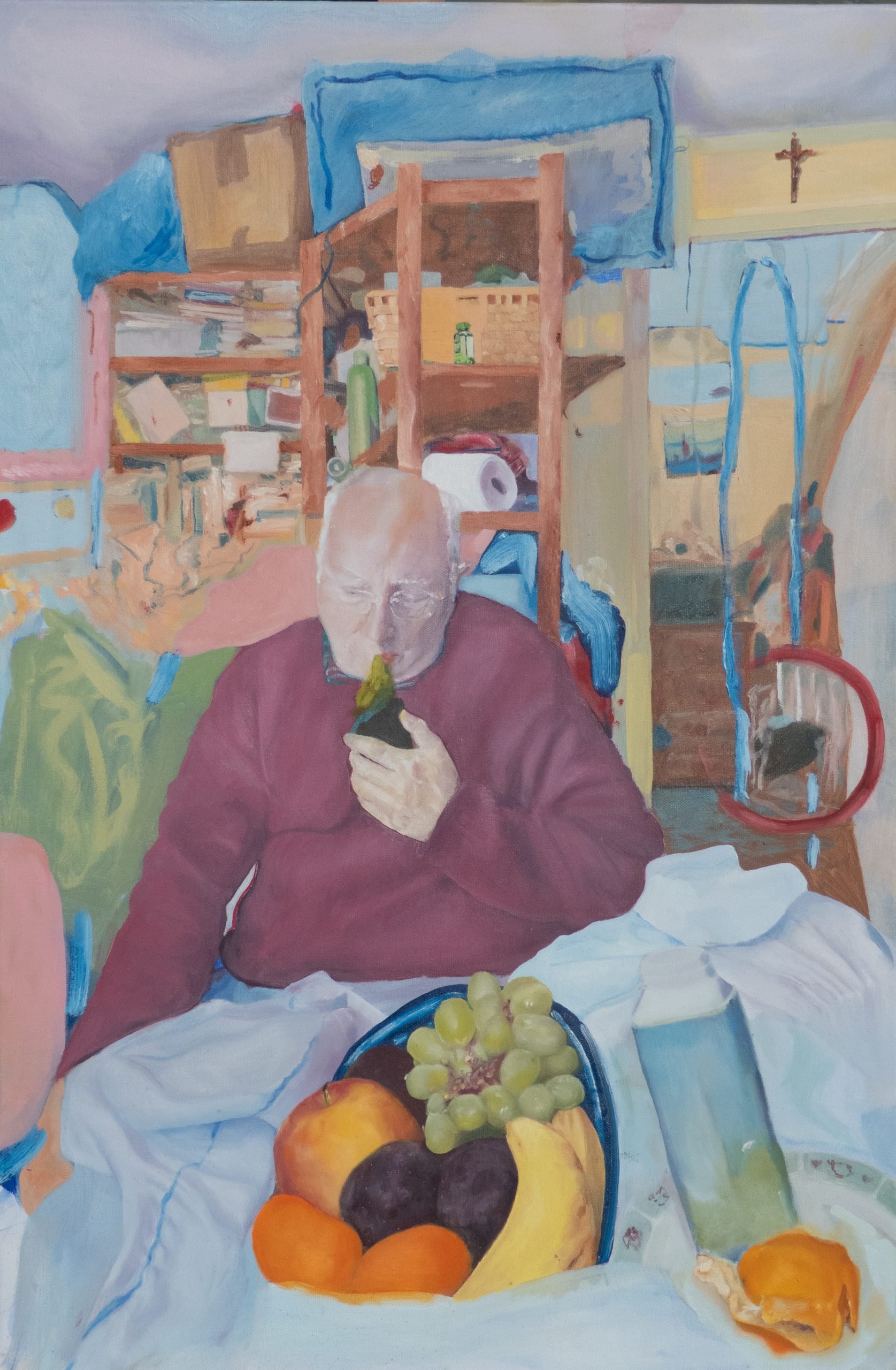
24th Sept - 22nd Oct
Where feeling becomes form
Find your personality in oil painting through the exploration of art history, technique, and concept.
Under the guidance of Niamh Hegarty, this five-week course is designed to introduce you to the expressive and technical possibilities of oil paint.
Suitable for all levels, the course balances hands-on practical exercises with discussion, demonstration, and art historical reference, creating a supportive environment for both beginners and more experienced painters.
Across five weeks, explore mark-making, colour theory, composition, space, and form through guided experimentation. Emphasis is placed on techniques of painting (Grisaille, Alla Prima, Glazing) used as part of an intuitive process, encouraging students to move beyond perfection and develop confidence in their own visual language.
As you deepen your skills and understanding, the course then moves into landscape and figurative painting, helping you understand how emotion, concept, and technique can work together. Each week, you will develop ideas for a final painting, gradually building toward a resolved work that integrates the skills learned.
Each session includes short demonstrations, structured exercises, and individual feedback, alongside group discussion informed by historical and contemporary painters.
With a total contact time of 10 hours, by the end of the five weeks, you will have gained a stronger technical foundation in oil painting, a deeper understanding of art historical approaches, and a completed final piece reflecting your individual interests and sensibilities.
Materials Students Should Bring
Required
– Oil paints: Titanium White, Cadmium Yellow (or Yellow Hue), Yellow Ochre, Cadmium Red (or Red Hue), Alizarin Crimson, Ultramarine Blue, Burnt Umber
– Paint brushes: A selection of hog hair or synthetic oil brushes in assorted sizes (flat and filbert recommended)
– Medium: Linseed oil or odourless painting medium
– Solvent: Odourless mineral spirits or equivalent
Recommended
– Additional Oil Paint Colours
– Apron or old clothing
– Sketchbook and pencil (for planning and composition)
– Reference images (printed or on a device)
– Palette knife (Medium-sized, flexible blade)
Materials Provided
– Easel
– Painting surfaces: Canvas, canvas board, and primed paper (multiple small surfaces and one large)
– Jars, Palettes and Cleaning Materials
– Limited Oil Paints and Brushes
– Odourless Solvent and mediums
– Selection of Reference Images
Thursdays, 24th Sept – 22nd Oct
5-Week Course: €270
Limited spaces available.
WEEK-BY-WEEK LESSON PLAN
Week 1 — Introduction, Mark Making & Materials
Focus: Becoming comfortable with oil paint
Practical Topics
– Introduction to oil painting materials
– Brush handling and mark-making
– Working from intuition rather than perfection
– Paint thickness, gesture, and surface engagement
Exercises
– Abstract mark-making exercises
– Exploring different brush types and tools
– Working with limited colour and texture
– Glazing
Art Historical References
– Vincent van Gogh — expressive brushwork
– Frank Auerbach — materiality and surface
– Joan Mitchell — gesture and emotional mark-making
Irish Contemporary References
– Diana Copperwhite — expressive brushwork
– Shane Berkery— materiality and surface
– James Kirwan— gradient and abstract mark making
Outcome
– Students feel confident handling oil paint and understand that painting is a physical, expressive process.
– Students consider concepts for a piece they would like to work on. Consideration of what emotions/concepts or subjects are associated with this piece. Association with mark making and subject.
Week 2 — Colour Theory & Mixing
Focus: Understanding and controlling colour
Practical Topics
– Primary, secondary, and tertiary colours
– How to mix colour
– Warm vs cool tones
– Value, saturation, and harmony
– Creating a limited palette
Exercises
– Colour mixing charts
– Painting small colour studies
– Translating emotion or atmosphere through colour
Art Historical References
– Henri Matisse — colour as expression
– Josef Albers — interaction of colour
– Pierre Bonnard — colour relationships and mood
Outcome
– Students learn to mix confidently and understand how colour choices affect mood and form.
– Students consider colour concept for the piece they would like to work on. Consideration of what emotions/concepts or subject are associated with this piece. Association with colour and mood to express subject.
Week 3 — Shape, Form & Space- Sketching Final Piece
Focus: Building images through shape rather than detail
Practical Topics
– Seeing objects as shapes
– Positive and negative space
– Creating depth and structure
– Composition basics
Exercises
– Still-life painting using simple shapes
– Tonal blocking
– Working from observation
Art Historical References
– Paul Cézanne — structure and form
– Giorgio Morandi — space and quiet composition
– Diebenkorn — abstraction and spatial relationships
Outcome
– Students understand how to organise space and construct paintings that feel balanced and intentional.
– Students consider composition for the piece they would like to work on. Consideration of what shapes are associated with this piece. Sketch drawn up for the main piece.
Week 4 — Landscape Painting and Working on the Final Piece
Focus: Translating space, atmosphere, and environment
Practical Topics
– Foreground, middle ground, background
– Atmospheric perspective
– Simplifying complex scenes
– Painting from reference photos
Exercises
– Landscape studies
– Exploring mood and light
– Working with colour temperature to suggest depth
Art Historical References
– J.M.W. Turner — atmosphere and light
– Claude Monet — light and colour perception
– Paul Henry
Outcome
Students learn to interpret landscape rather than copy it, focusing on atmosphere and structure. They work on their final piece.
Week 5 — Figurative Painting and Working on the Final Piece
Focus: Introduction to the human figure
Practical Topics
– Proportion and gesture
-Seeing the body as shape and movement
– Expressive rather than realistic figuration
Exercises
– Painting from photographic reference
– Gesture studies
– Final piece integrating skills from the course
Art References
– Lucian Freud — paint and flesh
– Jenny Saville — expressive portraiture
– Shane Berkery — colour association and the figure
Outcome
– Students work on their final piece
Niamh Hegarty

Niamh Hegarty is an Irish painter and printmaker who graduated from the National College of Art and Design with a BA in Fine Art Printmaking and Visual Culture. Her current practice focuses on oil painting and is informed by an interest in Surrealism. She produces a significant number of commissioned works each year, and her paintings are held in international private collections across Australia, the United States, Ireland, and the UK.
Her exhibition history includes Páipéar with Hang Tough Contemporary Gallery and As Real as a JPEG at the National College of Art and Design. Niamh is a recipient of the Black Church Studio Graduate Award and the NCAD Staff Prize, and her work is held in the Office of Public Works (OPW) collection.
Other Events


